IFRS 9 and the DCF methodology
The accounting models for credit impairment have received a big boost from the International Accounting Standards Board (IASB) and the Financial Accounting Standards Board (FASB). The FASB has proposed the current expected credit loss (CECL) accounting standard to calculate expected credit losses in the US. The International Financial Reporting Standards (IFRS) 9 is IASB's standard to estimate credit losses internationally. There are a few key differences between the CECL and IFRS 9 standards regarding their approach to calculating Estimated Credit Losses (ECL). One of the areas of difference is the model selection criteria. While CECL allows financial institutions to select the right measurement model, the IFRS 9 standard prefers to use the Discounted Cash Flow (DCF) methodology.
IFRS 9 offers few choices to institutions outside the US that are seeking to implement this accounting standard. Therefore, the accounting standard board, after thorough consideration, has decided that the DCF approach for calculating ECL is best suited for their needs and those institutions that fall under their jurisdiction.

Why the IFRS 9 prefers the DCF method
For IFRS 9, the ECL for a financial instrument is the difference between cash flows that are expected to be received and the contractual cash flows that are due. Given that, the discounted cash flows approach to calculate ECL is preferred under IFRS 9.
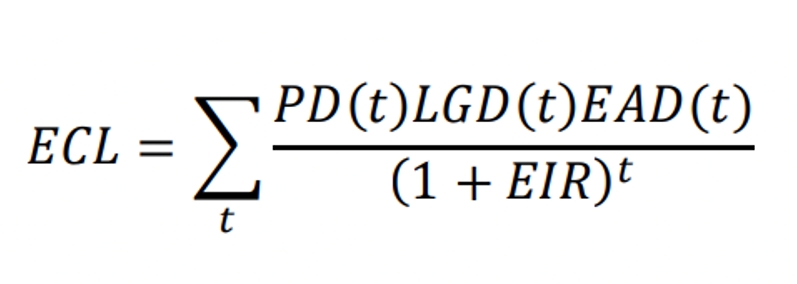
In the above calculation, future losses at time "t" are estimated using values such as:
- Probability of Default (PD)
- Exposure at default (EAD)
- Loss Given Default (LGD)
- Effective Interest Rate (EIR)

Understanding EIR
The interest the bank charges on a borrowed sum is known as the advertised interest rate or nominal interest rate. The effective interest rate reflects the actual cost of borrowing to the consumer and is normally higher than the advertised interest rate. The EIR includes amortization effects as well as components such as administrative charges or service fees for processing and approval of a loan.
Core principles for using the DCF method
- Loans are priced according to their Probability of Default (PD), so the profit banks make offsets the funding of any capital that they have to hold.
- Not all banks refresh their PD all the time. If they do not, it does not work because one of the things they are supposed to capture is the deterioration of the PD itself.
- The other thing that is needed for the DCF calculation is the EIR. It is not the most complicated value to be calculated, but it needs to be done because of the methodology used within this calculation.
Points to consider while using vendor services to implement CECL
- While selecting a vendor, institutions need to ensure that vendors calculate the EIR. The only data they should ask for is the credit score. Vendors should also supply the curve that the credit score goes against.
- Data such as the EIR and PD curves can be calculated or obtained from external sources, and therefore the vendor should supply it. The credit score belonging to clients of financial institutions is not accessible from the outside.
- When we see the formula for ECL, we can observe the losses and the EAD, but we are discounting that by the EIR because we are discounting that by what the bank actually charges. If implemented successfully, the DCF method can be considered one of the most accurate ones.
CECL Express can help…
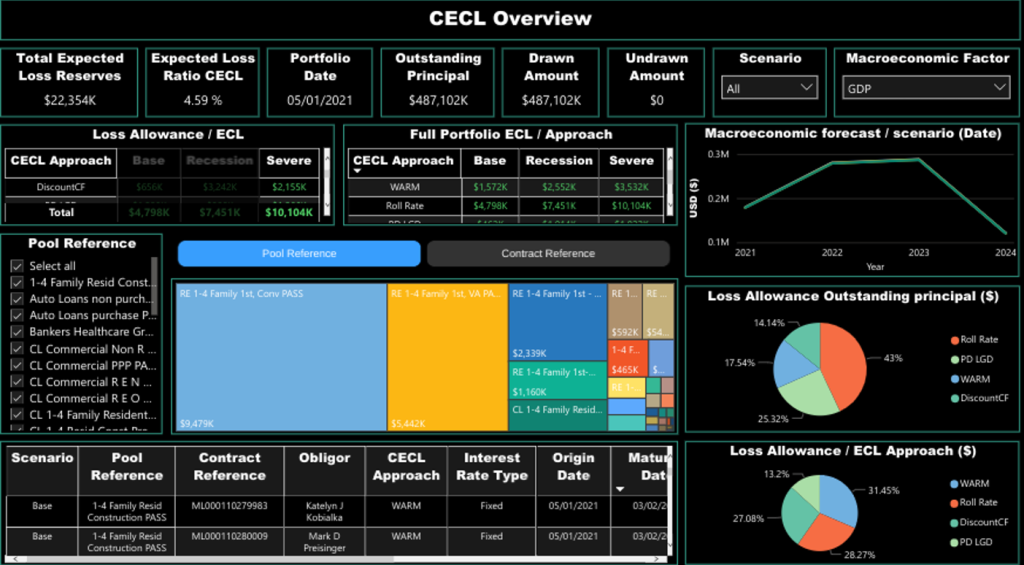
CECL Express is a turnkey solution that fully satisfies all elements of the new CECL accounting standard. The system provides all non-loan data, including:
- Yield curves and Fed data
- Linked reports on losses from the FFIEC and NCUA
- PD and LGD curves
- Macroeconomic data
Banks and credit unions need to only provide the underlying loan details for the system to provide fully auditable ECL results for multiple calculation methods, including:
- Vintage
- Roll Rate
- Discounted Cashflow
- WARM
- PD/LGD
CECL Express provides more than valid ECL results. The system computes results for all methods and all loan pools, allowing the bank to optimize its CECL configuration and avoid the worst impacts of the new standard.