CECL and call reports
The Financial Accounting Standards Board (FASB) issued the Current Expected Credit Losses methodology (CECL), a new accounting standard for estimating allowances for credit losses. This new accounting standard applies to all banks, credit unions, and savings associations that file regulatory reports, which conform to the Generally Accepted Accounting Principles (GAAP) of the US. CECL replaces the incurred loss methodology and instead relies on estimating expected credit losses using various methods.

What are call reports?
A call report is a regulatory document that American banks are required to submit to the Federal Deposit Insurance Corporation (FDIC) on a quarterly basis. By comparing several call reports, it is possible to gather information about the health of the US banking system.
- Call reports are quarterly financial condition reports sent to the FDIC by the US banks.
- The bank's management must approve and verify the report's contents.
- The size of the bank, and the capital standards applicable to it, decide its specific reporting requirements.
The call report contains several data, which are an indicator of the reporting bank's viability. Items within the call report include:
- Bank's income statement
- Loan information
- Deposit information
- Balance sheet investment information
- Asset sale information
- Changes in the bank's capital

Call report submission
Financial institutions file their call reports with the Federal Financial Institutions Examination Council (FFIEC). The public can access these reports on the Federal Insurance Deposit Commission website. Call reports are used by the banking industry to find out loss information for historical periods. Future expected credit losses are then predicted using this information.
Call report limitations
But is the data contained in the call report sufficient to arrive at accurate CECL results? Several other factors influence CECL calculations that institutions need to consider:
- Historical pattern in lifetime losses derived from call reports is not sufficient to arrive at accurate CECL results. We need the right economic indicator data to predict CECL allowances.
- As compared to public data sources, the vintage or year of origination is an important data source for calculating credit losses.
- The Weighted-Average Remaining Maturity Method (WARM) calculates an average quarterly loss rate while estimating reserves under CECL. Institutions choosing WARM should also use their internal data to subdivide portfolios by riskiness.
- While call report data may be an important source for benchmark information, the calculation of historical loss rates should involve systematic analytical capabilities.
- Besides historical information, CECL should consider reasonable forecasts of future events and current information along with prepayment estimates.
- The analysis of how historical data measures against peer experiences and industry benchmarks is important and should be given due diligence in CECL.
- Banks should know the duration of their loans and factor in the categorization of these loans, rather than be too dependent on call report data alone.
- The vintage loss rate methodology has to ensure that the vintage pool reflects the risk profile of loans in the pool — something that call reports do not address.
- While using the WARM method, the portfolio has to be split based on riskiness so that we do not average away the risk and granularity that is supposed to be captured.
Measuring CECL allowance accurately is a challenge for most financial institutions, especially smaller establishments. Banks must use both external and internal data for their model-based approaches while calculating CECL.
CECL Express can help…
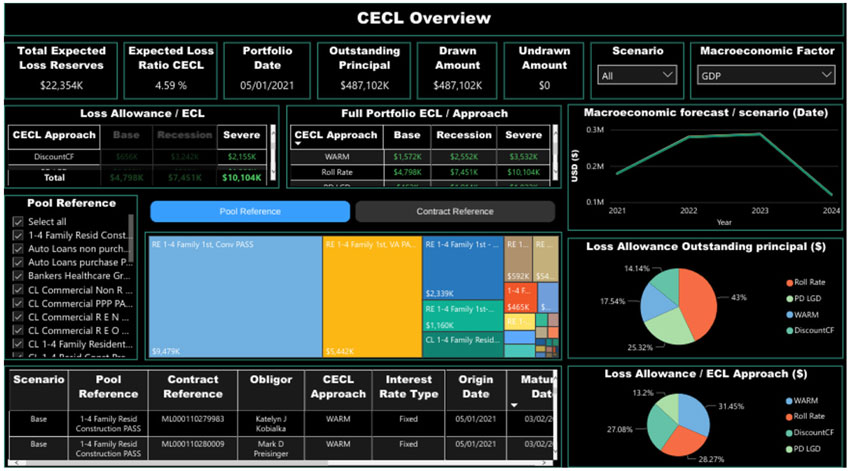
CECL Express is a turnkey solution that fully satisfies all elements of the new CECL accounting standard. The system provides all non-loan data, including:
- Yield curves and Fed data
- Linked reports on losses from the FFIEC and NCUA
- PD and LGD curves
- Macroeconomic data
Banks and credit unions need to only provide the underlying loan details for the system to provide fully auditable ECL results for multiple calculation methods, including:
- Vintage
- Roll Rate
- Discounted Cashflow
- WARM
- PD/LGD
CECL Express provides more than valid ECL results. The system computes results for all methods and all loan pools, allowing the bank to optimize its CECL configuration and avoid the worst impacts of the new standard.